
How to Design a Sample Kit for Building Products: A Manufacturer's Guide
Author: Akif Öztürk · Published: September 12, 2026
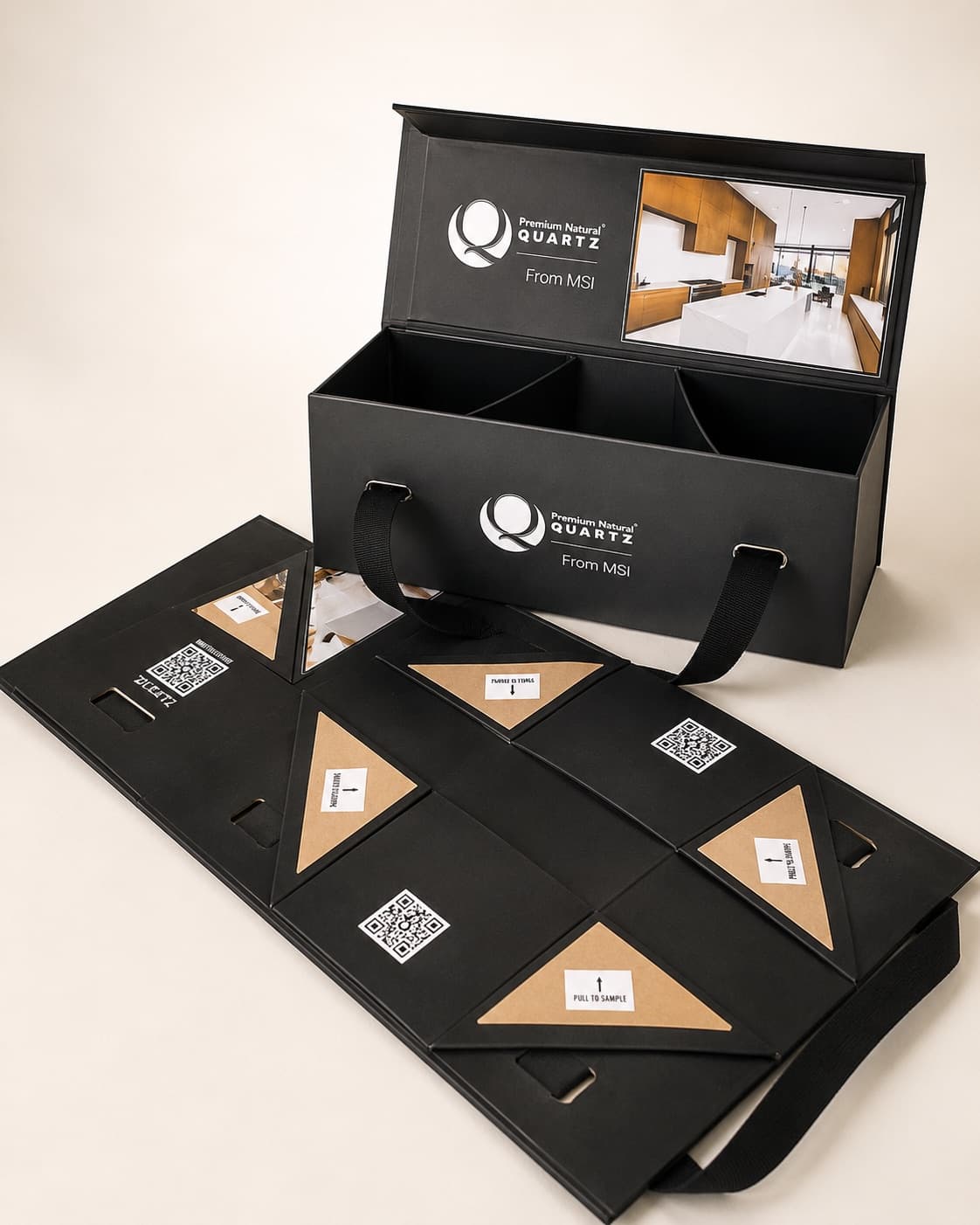
Ask an architect what happens to most product samples and the honest answer is a drawer. A loose tile chip with no label, a fabric swatch that lost its card, a quartz piece too heavy to keep on the desk. The kit that stays out on the table, and gets pulled back out when a project comes up, is the one that was designed as an object, not just filled.
Most of what is written about sample programs covers the marketing side: which products to sample, how to reach specifiers, how to track requests. What tends to go missing is the physical side. How much does a full set of stone samples actually weigh, and what does that do to a lid? Which insert holds a 20 millimeter quartz piece without letting it chip its neighbor? How do you build a kit so that the reorder two years later matches the first run?
We build sample kits by hand in our workshop in İzmir, for surfaces, tile, flooring, textile and hardware brands, including the dealer sample kit for MSI's Premium Natural Quartz line. This guide walks through sample kit design from the manufacturing side: what the kit has to do, how sample size and weight dictate the structure, insert and closure engineering, fold-out boards, labeling, what drives cost, and how to design for year two rather than just the launch.
Start With the Decision the Kit Has to Support
A sample kit is a sales tool, and the first question is which sale. An architect's material library needs a kit that files: a defined footprint, a spine or edge that reads on a shelf, samples that come out and go back without a fight. A dealer showroom kit is opened hundreds of times by different hands and has to survive that, so hinge strength and lid alignment matter more than a spine. A representative's leave-behind travels in a car boot and lands on a client's desk, which is where carry straps, protective corners and a printed lid interior earn their keep.
The same product line can need two or three of these. The mistake is designing one kit for the showroom and then shipping it to five hundred architects, or the reverse. Decide who opens the kit, where, and how often, before anyone draws a box. Everything below follows from that answer.
It also helps to decide early what the kit is not. A sample kit is not a gift box: it is refreshed with every collection, restocked as dealers join and reissued when a line changes. That makes it a program, and a program is designed once and reordered many times.
Sample Size and Weight: The Numbers That Dictate Everything Else
The single most useful thing you can send a manufacturer is the real dimensions and weight of your samples, not a description. Quartz and natural stone weigh roughly two and a half grams per cubic centimeter. A 10 by 10 centimeter piece cut at 2 centimeters is about half a kilogram. Twelve of those in one kit is six kilograms before you add the box, and that number decides the board thickness, the base construction, whether a strap is even possible and how the kit ships.
Porcelain and ceramic tile chips are lighter per piece but sharp at the edges, so the concern shifts from load to abrasion: a chip that slides in transit scratches the one next to it and scuffs the wrap paper. Fabric memos weigh little but take up volume and need to stay flat. Hardware finish samples are small, dense and easy to lose, so the insert has to hold each piece by its shape.
Standardize the sample format before the kit is designed. Kits that carry three sizes of chip because three product lines were sampled at different times end up with compromises in every compartment. A single format per material lets the insert be cut once, filled quickly and refilled by anyone.
Insert Engineering for Heavy Samples
The insert is where a stone or quartz kit is won or lost. There are three broad approaches. Board dividers, cut from the same greyboard as the box and wrapped or left plain, form compartments that hold several pieces on edge; they are economical, easy to refill and suit dealer kits where pieces come in and out constantly. Die-cut foam or EVA gives each piece its own cavity so nothing touches, which protects polished faces and suits heavy pieces that must not shift; it costs more and fixes the layout, so it belongs in kits where the sample set is stable. Thermoformed plastic trays hold their shape well but sit awkwardly with FSC-certified board and premium wrap papers, and we rarely recommend them for a kit that has to feel like the brand.
For the MSI Premium Natural Quartz dealer kit, the case is a black magnetic-lid rigid box with divided compartments sized to the quartz sample pieces, a printed lid interior and a woven carry strap anchored through metal eyelets. The compartments hold the pieces on edge so the set reads like a fanned deck when the lid lifts, and the base is built to carry the full weight of the set without bowing.
Whatever the insert type, confirm it on a physical prototype with your real samples, not a rendering. A cavity that looks right on screen can be a millimeter tight in the hand, and a millimeter is the difference between a piece that lifts out cleanly and one that needs a fingernail. We build the prototype in the actual materials and courier it before any run starts.
Lids, Magnets and Straps: Closure Strength Versus Load
A magnetic lid is the right closure for most sample kits because it opens with one hand and closes with a snap that stays closed. The engineering question is load. Two small magnets that hold a lightweight gift box shut will not hold a six kilogram stone kit if the box is ever carried lid-down or tipped in a car. We size the magnets and their recessed placement to the lid geometry and the total kit weight, and on heavy kits we add a third pair or a wider magnet at the front edge.
A carry strap turns the kit into a bag, which is exactly what a representative wants and exactly what tears a box that was not built for it. The strap has to anchor through the body of the box, not just the wrap paper, with metal eyelets or a reinforced board panel spreading the load. On the MSI kit the woven strap passes through eyelets set into a reinforced front panel, so the weight of the quartz hangs from the structure of the box rather than from its skin.
Corners take the abuse in transit. A rigid box with taped corners under the wrap, and a base wrapped with turned-in edges, survives being set down hard on a counter a hundred times. That construction detail is invisible in a photo and obvious after a year of use.
Fold-Out Sample Boards and Tear-Off Pieces
Not every sample needs a compartment. For thinner materials, laminates, small tile chips and printed color references, a fold-out sample board does a different job: it lays the whole range out flat in one motion, labeled and in order. The MSI kit pairs its case with a companion fold-out board carrying tear-off sample pieces and QR codes, printed on the same black stock as the case, so the two read as one object.
Tear-off pieces solve a real problem architects raise: they want to take a piece away for a project file without dismantling the kit. A board with perforated or lightly tacked pieces lets them do that while the main set stays complete. Print the product name and code on the board under each piece, not only on the piece, so the empty slot still tells the reader what was there.
Boards and cases are planned on the same technical drawing. Print areas, fold lines, cavity positions and the position of every label sit on one document, which is how you avoid a QR code landing on a crease or a lid graphic colliding with a divider.
Swatch Boxes, Memo Boxes and Finish Sets
Textile and wallcovering houses work in memos: a swatch on a labeled card, held in a box or a fanned holder. The structure here is about order and refilling, not weight. Tabbed dividers by collection, a slot that takes a standard memo card and a lid that stays open on a desk matter more than magnets. A drawer format works well for larger ranges because it reads as a library and can be reordered one drawer at a time.
Hardware brands need finish sample sets: a dozen small pieces of the same profile in different plating or powder-coat finishes. Each piece sits in a cut cavity shaped to the part, with the finish name printed under it. The box is small, dense and handled constantly, so the wrap paper and the corner construction take the same care as a much larger stone kit.
Paint and coating brands sit between the two: color chips or coated panels, usually in a fold-out or drawer format, with the color system printed alongside so the kit doubles as a specification document.
Labeling, QR Codes and the Spec Sheet Architects Keep
A sample that cannot be identified is worthless in a library. Label every piece, and label the slot it came from. Put the product name, code, size and finish on the back of the sample where possible, and repeat it on the insert or board. A printed lid interior is prime space: the brand, the collection and a lifestyle image on one side, a legend of what sits in each compartment on the other.
QR codes should go somewhere that survives handling and does not sit on a fold. Link each one to the product page, a downloadable technical sheet or a dealer locator, and give the kit a single QR for reordering so a dealer can request a refill without an email chain. On the MSI kit the QR codes sit on the box exterior and on the fold-out board beside the samples they belong to.
Include a printed spec sheet in a slot of its own. It is the one piece of paper that gets filed with the samples, and it should carry the same code system as the labels so the two can be matched a year later.
What a Custom Sample Kit Costs, and What Drives It
Reading a quote is easier when you know where the cost lives. The first driver is structure: a plain lift-off lid box is the cheapest form, a magnetic lid adds magnets and a hinge assembly, a strap adds eyelets and a reinforced panel, and a drawer format adds a second box inside the first. The second driver is the insert: board dividers are quick to cut and assemble, die-cut foam takes tooling and more time per unit, and a fold-out board is effectively a second printed product.
The third driver is finishing: wrap paper choice, hot foil, embossing and spot UV, printed lid interiors and printed boards. The fourth is run size, because one-time work such as the structural drawing, the prototype and any dies is spread across the units you order. Minimum quantities are set per kit model and dimensions rather than fixed at one number; a pilot run for a single dealer region and a full program rollout are built with the same hand craftsmanship, and unit price improves as the run grows.
Where the kit is made changes the timeline more than the price. Kits produced in İzmir reach most European destinations by road freight in a matter of days; US programs ship by air or sea depending on volume and timing. That matters most for the refill runs, which are usually smaller and more urgent than the launch order.
Design for Year Two: Reorders, Refills and Program Logistics
The launch run is the easy part. The kit earns its cost in the years after, when new dealers join, collections change and pieces go missing. Design for that from the start. Keep the sample format fixed so a refill fits the original insert. Keep the printed legend separate from the structural print where possible, so a collection update means a new board or lid card, not a new box.
On the manufacturing side, ask your supplier to keep the dieline, the wrap specification and the insert tooling on file, and to build reorders to the same drawing in the same materials without repeating the sampling round. Ask whether runs can be split by region or dealer network and delivered in batches against a program calendar, and whether the kits can ship to a fulfillment partner or straight to a distribution center.
Sample kits are often commissioned by the agency, display house or sampling platform running the brand's program rather than by the brand itself. If that is your situation, look for a manufacturer who works as a production partner: quotes to you, ships where you need, and leaves the client relationship with you.
Frequently Asked Questions
How much does a custom sample kit cost? It depends on structure, insert, finishing and run size, in that order. A quote needs the sample dimensions and weights, the number of pieces per kit, the closure and strap requirement, the print list and the quantity; with those, we typically respond within 24 hours.
What is the minimum order for a sample box? Minimums are set per kit model and dimensions. Short pilot runs and full program rollouts get the same construction, and the exact quantity and unit price are confirmed at the quote stage.
How heavy can a magnetic-lid sample box be? Heavier than most people assume, provided the magnets, base and strap anchoring are sized to the load. A stone kit of several kilograms is routine when the structure is engineered for it and confirmed on a physical prototype with the real samples.
How big should material samples be for architects? Big enough to show the pattern and finish, small enough to file. A single format per material, with the product code on the back, does more for a specification library than a larger piece with no label.
How long does it take to produce a sample kit? Once dimensions and design are agreed, a physical prototype is usually ready within days. Production time depends on quantity, insert type and finishing and is locked at the quote stage, with transit planned from the destination.
Bring Us Your Samples
The fastest way to start is to courier a set of your real samples to the workshop, or send their dimensions and weights with a note on who opens the kit and where. We engineer the structure from there, prove it on a prototype in the actual materials and plan the run around your program calendar.
Get a clear quote for your project
Share your dimensions, quantity and timeline; we typically reply within 24 hours.